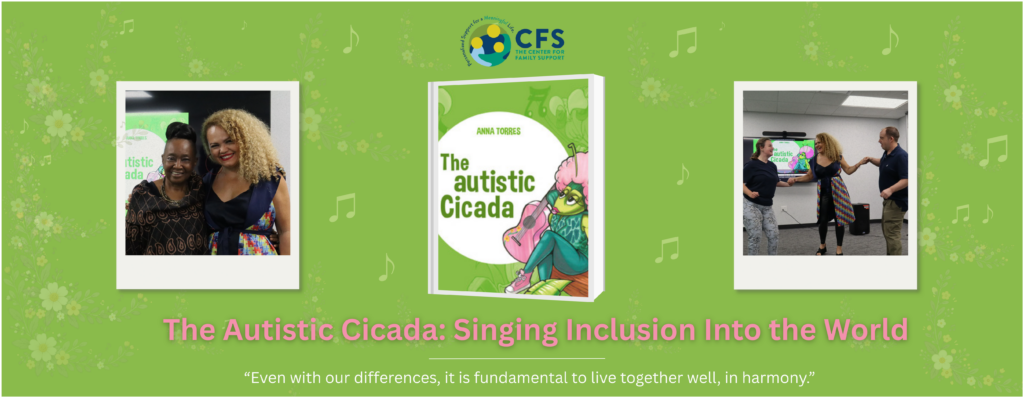
Watch: Anna speaks about her experiences at CFS HERE.
Anna Torres believes that art can say what words sometimes can’t, and that a song can open doors that society has kept closed for too long. A Brazilian children’s book author, artist, and musician, Anna visited the Center for Family Support (CFS) on Thursday, September 10, for a workshop with individuals with autism, as well as individuals with intellectual and developmental disabilities. The day marked the New York premiere of her animated short film, The Autistic Cicada, and the launch of her book and CD. Anna also sang for everyone in the room.
Her story begins at home. Anna is the mother of Mariana, a 16-year-old young woman with autism. Mariana was diagnosed at age three, shortly after she started school. The news left the family sad and lost, and the years that followed were hard. It was difficult to find good support for their daughter, and the family went through a lot of hardship supporting Mariana at home.
Then Anna made a decision. “Mariana needs my smile much more than my tears,” she remembers telling herself. She began to sing more, play more, and experiment with voices. Anna had previously done voice work, but she says she never truly knew how many voices she had inside her. In The Autistic Cicada, she performs eleven of them herself.
What started as a kind of self-therapy grew into something larger. “This project is more than self-help, more than self-therapy,” Anna said. “It will serve me, but it will also serve other people, other families who are going through the same difficulties, the same suffering.” She began reaching out to associations that advocate for autism, and she says joining hands with them made her stronger as well.
The result is a story with a heroine who is rarely seen. The Autistic Cicada follows Sibelle, an autistic cicada who lives in the Amazon rainforest and finds ways to express herself through art and music. Anna describes her protagonist as an artist, ecologist, and altruist. Because all cicadas “sing”, Sibelle dreams of becoming a professional singer. Along the way, the story speaks about caring for the planet, believing in your dreams, and peace.
The songs throughout the film carry that message too. In “Musical Notes,” Anna explains that the notes do, mi, and sol can’t make a chord without one another. “Even with our differences, it is fundamental to live together well, in harmony,” she said. “What would the doctor be without the person who cleans? What would the pilot be without the farmer?” Another song, “Rainbow,” celebrates the world’s many colors and origins. The book also reminds young readers of the magic words, like please, thank you, and excuse me, which Anna says people are in danger of forgetting.
For Anna, it was important to tell this story because she realized it was never only about her. “I could raise this flag very high and shout to the whole world,” she said. She wants people to see that autistic people have real strengths and can contribute to society. She also wants public services to improve, noting that there are still too few centers that serve autistic people. And while she says society’s gaze has started to change, there is still a long way to go. Part of what makes the story special, Anna says, is that it’s rare to see a project where the main character is autistic.
“The first step for society to change is to talk about it,” Anna said. “The second is for that society to reflect, so that there can be a change in favor of inclusion.”
Her message for readers and viewers is that autistic people need a more attentive and more sensitive gaze. Anna points out that disability can touch anyone, through illness, an accident, or growing older. “People become sensitive to disability when they become disabled themselves,” she said, so she asks for empathy before that moment arrives. “I want society to include people with disabilities, so that a wheelchair user can go to a movie theater, can go to a football game, so that a person with autism or Down syndrome can be anywhere in society.” Anna has taken part in a Fashion Week in London where the models had disabilities. “I think it’s beautiful to show that, because people with disabilities also consume. They get dressed, and yes, they can be models.”
The cicada’s journey has already taken Anna far. She has performed the project in Paris and toured cities in France and Brazil, including Rio de Janeiro and Maranhão. The book and CD are available in five languages: Portuguese, French, English, Spanish, and Mandarin. The animated film reaches even further, in nine languages, adding Italian, Japanese, German, and Arabic. Next, Anna is headed to Brazil, then England, with Geneva, Switzerland already on the calendar and a possible trip to China.
Behind it all is a lot of work. Anna produced and directed the entire project herself, and she describes it as a “great battle” as an artist, alongside the great battle of her day-to-day life as the mother of an autistic daughter. That’s why seeing the film travel the world means so much. “It’s grand for me,” she said. “It’s like saying, ‘You were right. You were right to invest in this project.’”
The cicada’s story is one Anna lived, a story of exclusion that she lived herself. “I hope this message moves the whole world,” she said, “that people see how much exclusion hurts, and that they begin to include more.”
Listen to the full audio and songbook of The Autistic Cicada HERE.